
Almost every marketing team I talk to is trying to figure out some version of the same thing: How do we get other people talking about us?
Makes sense. LLMs lean heavily on third-party content. LinkedIn posts, Reddit threads, YouTube videos, G2 reviews. Not just your website.
Navattic figured this out three years ago, mostly by accident. They built an advisor program: about 20 people who give feedback on the product and talk about Navattic where their buyers actually hang out. (Full disclosure: I’m one of them.)
It’s not equity everyone forgets about after three months. It’s not $500 a post. It’s closer to a community.
So I sat down with Natalie Marcotullio and Meredith Gershenson, who run it, to walk through how it started, how it’s structured, and how they measure it. (Spoiler: they’re now cited for most of the AI prompts they care about.)
The conversation is below, lightly edited. Full video right below.
Watch the full conversation
How it started
JOHN: Tell us about the origins of the advisor program. It's become pretty well known, and there are a lot of advisors in it now. How did it start, and what problem were you trying to solve?
NATALIE: I'd love to say I had a master plan. We're going to bring on this many advisors, one from each discipline, all mapped out. Honestly, it started very organically.
Early on at Navattic, probably my first year, I kept meeting people who were already talking about topics close to interactive demos. Andrew Capland, who you know well, had experimented with homegrown interactive demos at some of his past startups and was posting about it. We started chatting on LinkedIn. There were a few others like that I met at events or on LinkedIn, and they were mentioning Navattic or interactive demos on their own. I thought, this is great.
At some point, I think it was Andrew who said, "Should we make this a more formal thing?" That got me thinking. How could we take people who were already thinking about the topic, connect them to the bigger problem we're trying to solve, which is making B2B buying easier, and work with them in a more long-term way? Random posts where they might mention us are great. It just felt like there was more we could do.
JOHN: Did you see the "third parties need to be talking about your brand" shift coming with AEO? Or did starting when you did just make you look like a genius in hindsight?
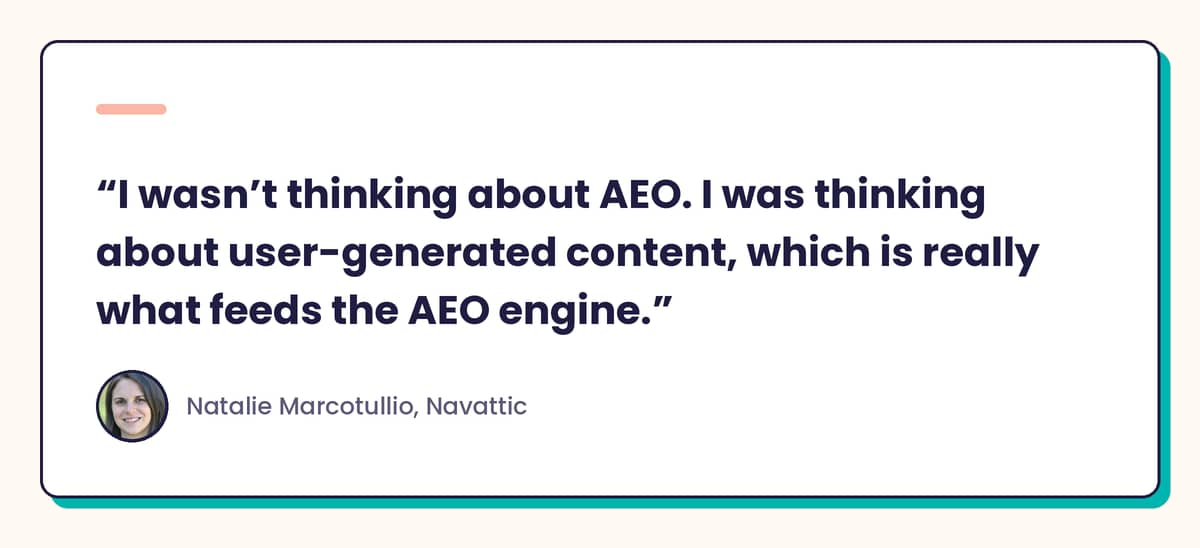
NATALIE: I'll take it, but absolutely not. I definitely wasn't thinking about AEO. I was thinking about user-generated content, which is really what feeds the AEO engine now.
It started from this: we sell to marketers, and I'm a marketer. I can spot marketing from a mile away. When I see a LinkedIn ad, I can see the game being played. It was more the realization that people want to buy from people they trust. So how do we make sure we're associated with people they trust?
How it grew
JOHN: It started like everything does, with one or two people. Where is it now, and how quickly did you get there?
NATALIE: We experimented with one or two people for a little while. For the first six months, it was probably about five. Then we said, "This is working, we should expand it," and got to about 10. Since then, we've added one or two people at a time, really intentionally. And honestly, it's not planned. I'll meet someone amazing who's just a great fit and think, "You'd be a fantastic advisor." But we're not putting it out there.
One thing we did spin up this year: it worked so well for our marketing persona that we started a second advisor group for solution engineers, another persona we work with a lot. We have five SE advisors now.
JOHN: So you're starting back at the beginning with that group. What's the total now?
NATALIE: About 20. Roughly five the first year. When we decided to scale up, we got to 10 to 12, and it stayed pretty consistent for a while. Adding the SEs scaled it up by another five.
How it's structured
JOHN: How do you structure each relationship?
NATALIE: One thing that's a little unique: most advisor programs are one of two things.
One is the classic advisor role, which I actually do for a few startups myself. You get a certain amount of equity, and you advise an early-stage marketer, their marketing hire, or their team. You bring domain expertise. It's a lighter commitment, and it's much more about your strategic expertise.
On the flip side, there's pay-per-play. "Here's $500 to post about us on LinkedIn." Or a campaign: "Post, make a YouTube video, and write about us in your newsletter for $1,000." That's much more like a sponsorship.
We decided to mix the two. Our advisors actually advise us. They give us feedback, they hear about product updates and big initiatives we're working on, and we ask what they're seeing in the market. They also help promote us, on LinkedIn and in their own content channels. And it's a monthly payment, not equity and not a one-time payment.
JOHN: How did you get leadership to say yes to that structure? Did it come top-down? How did you pitch it internally?
NATALIE: Again, it was pretty organic. The first few people we worked with actually pitched it to us a bit: "Hey, we want to work together." Our leadership was certain they didn't want the typical equity model. And this was before the pay-per-post model even really existed. So it was, "Okay, if we're not giving them equity, I guess we'll pay them a flat rate."
It was a bit of a happy accident. And once it worked with a few people, it was very easy to pitch expanding it.
JOHN: Why run it as a program with a monthly commitment instead of pay-per-post?
NATALIE: At the time, pay-per-post just wasn't much of a thing. The people we were working with weren't asking, "Can you sponsor some of my LinkedIn posts?" They were saying, "I'd love to come on, formally advise, and help promote Navattic." "Let's work together in some capacity" was the more normal route back then.
And we knew we didn't want it to be just equity. I'd worked with equity-based advisors before. They're really involved the first few months, and then they fall off. So part of it was wanting a recurring payment. It's a reminder: yes, you're still working with us. This isn't going to just disappear.
JOHN: As an advisor myself, and an observer of all the others, I'd say you get a lot more this way. There are the posts, but also the comments, people collaborating, recording videos together. Pay-per-post feels more limited. This is more relationship-driven than any engagement like it I've had.
The point system
JOHN: As a participant, the most unique part, and it's relatively new, is the point system. How did advisors participate for the first few years, how did that evolve into points, and how does it work?
NATALIE: I'll talk about the evolution, then Meredith can walk through the point system, since she really came up with it.
I ran the program for the first three-ish, four-ish years. There was always an expectation to post a certain amount each month. It was technically in the contract, but to your point about it being relationship-based, we were flexible. If we had a big promotion, we might ask for a few more posts that month. If it was a slow month, or someone had something going on, they might not post at all.
A few things pushed us to change. As I got busier and took on more roles, the program relied on me saying, "We have something to post about," and sometimes things fell through the cracks. Advisors even asked me, "I'd like to know how I'm stacking up. Am I doing what I'm supposed to?" I was too busy, and not organized enough, to give a real answer beyond "You're doing great." I needed a formal way to measure it.
And we've all seen LinkedIn engagement tank over the past few years. Everyone I talk to says you can still get value from it, but it's nowhere near what it was when I started the program. We wanted to incentivize beyond LinkedIn, which is hard when it's been the main platform forever and the one everyone's most comfortable with.
So I gave Meredith the challenge: take this quarter and reimagine what the advisor program could be.
JOHN: Meredith, where did the point system come from? How did you land on the structure, and what did the brainstorming with Natalie look like?
MEREDITH: As Natalie said, she didn't have the capacity to manage it anymore, which is a credit to the amazing team of advisors she built. She asked if I'd take it on.
The point system came out of a one-on-one between the two of us, talking about how to hold the program accountable and gamify it a little. And what better way to get a group of people who are their own bosses, solopreneurs, that type of personality, to really get involved than a points program?
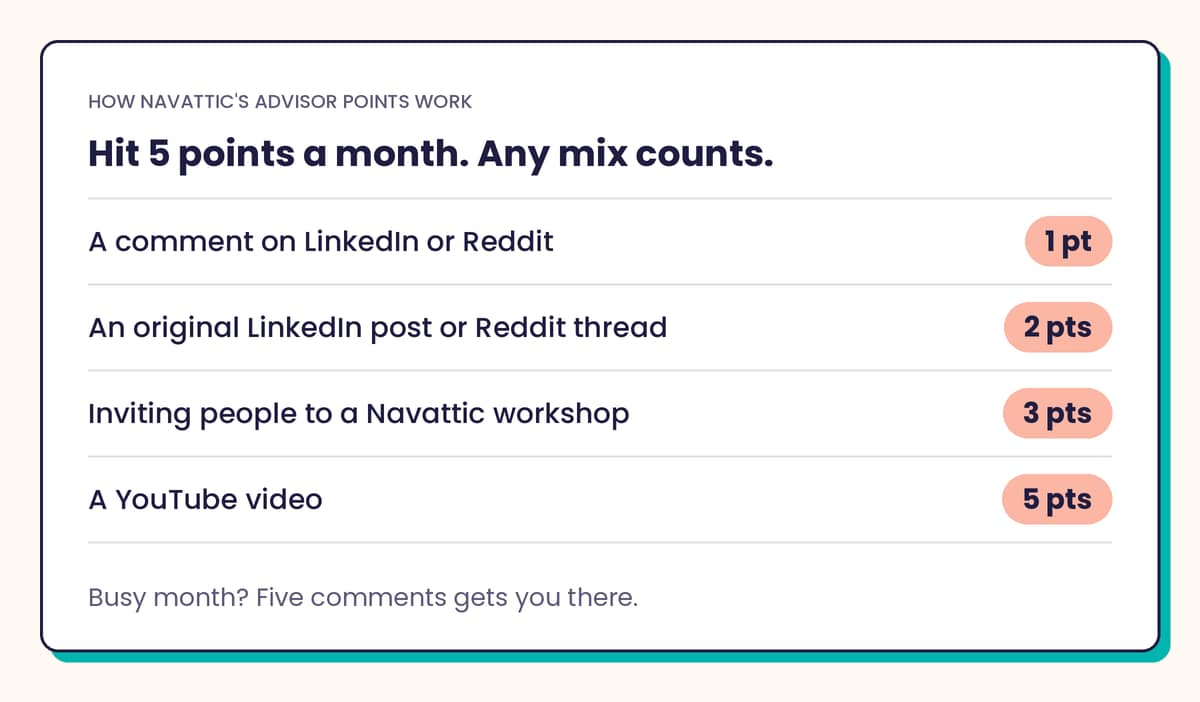
We started with the basics. A LinkedIn post that shouts out Navattic or interactive demos is two points. A comment is one. Then we kept going: a Reddit comment should be a point too, so we incentivize people to comment on Reddit more. A YouTube video could be a heavier hitter, maybe five points.
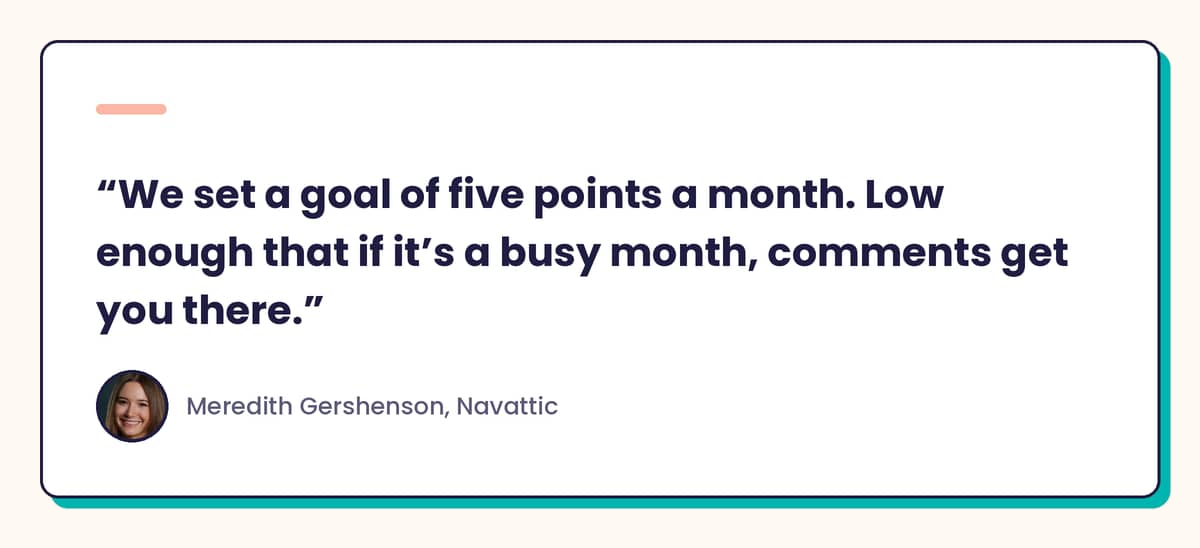
We set a goal of five points a month per advisor. That's low on purpose. A lot of our advisors are super busy. They sit on other boards, and some have full-time jobs. So if you hit five points with comments all month, perfect. Send them my way and I'll log them. If you have more capacity and you're motivated to make a PLG-style video about the top tools in your PLG tech stack, great. Go for it and send it to me.
Before we launched, we also asked the advisors: what actions would you be motivated by? What ideas do you have?
JOHN: Walk me through it. On the low end, a LinkedIn comment is a point, and a Reddit comment is a point. An original LinkedIn post is two. If someone starts their own Reddit thread, is that two as well?
MEREDITH: Exactly. It goes down the line, anywhere from one to five points. The heavier hitters are a YouTube video or our events. Natalie created these Navattic workshops, and they run all over the world now, which is crazy. If an advisor attends one, great. If they invite people to one, I believe that's three points.
So it depends on their capacity. But the whole premise was to reignite the advisor program. Natalie built an amazing team of very smart people, as you know, John, and it's really cool to see it lit up again. Advisors are sharing articles they found interesting, and people are reacting and commenting in the Slack threads. It breathed new life into the existing groups, and people have been really receptive.
The community part
JOHN: I don't want to gloss over this. You could have a group of advisors who never interact with each other, which is probably what most companies have. But you have a Slack group that feels like a community. People drop their Navattic-related LinkedIn posts or demo videos in there and talk to each other. And there's a quarterly advisor meeting. When I go into the advisor channel, it's taken on a life of its own. People comment on each other's stuff, and it creates collaboration. Was that intentional?
NATALIE: Another happy accident, which is the recurring theme. My big advice for anyone creating one of these programs: start with a few people and listen to their feedback. Build it off of them.
That's exactly what happened. Advisors told me they wanted to meet the other advisors, see what they were posting, and get to know them. I originally didn't create a Slack channel because I was worried about overcommunicating. Another Slack channel seemed annoying, and I didn't know if they'd want to meet each other. Then I got that feedback and realized it's actually one of the perks. Now when we pitch a new advisor, the community is something we promote: you get to meet these other fantastic advisors.
The quarterly meeting came from feedback too. For a while, our main communication besides one-on-ones was a monthly email update. Advisors said they wanted a pulse on how the business is doing and the big themes, to see the other advisors, and to brainstorm together.
So if you're launching your own, keep asking: how could we make this better? What would you like to see? Both of those ideas came from that.
JOHN: So it's all feedback-driven. And I think that's created a flywheel. The advisors are connected, and that's key. Take that out and the flywheel falls apart. Everyone is creating different content: LinkedIn posts, comments on each other's posts, videos, newsletter mentions. Everyone else sees it and can jump in, or gets inspired to write their own. Meredith, talk about that flywheel. Was it a happy accident too?
MEREDITH: To define it, a flywheel is small, consistent wins that boost the entire organization. Here, the organization is Navattic and the advisor program, and it's win-win on both sides.
When Natalie and I were brainstorming points, top of mind for me was, "An advisor's LinkedIn post would make an amazing thought leader ad I could promote from the Navattic page." So now the weekly message says something like, "We're launching Navattic Agents. Let's focus on agents this week. If you post about it, you get two points. Send me the link, drop it in Slack, and other people will engage. I'll put ad money behind it so more marketers see it." Marketers are our ICP.
Those small, consistent wins, the posts, comments, and YouTube videos, feed off each other and keep it going.
But no, I wasn't thinking about a flywheel when we built the points. It's a concept a founder at my last company told me about, and it stuck with me. Once I saw it happening here, I thought, that's really cool. There are consistent wins for Navattic, whether that's ROI or brand awareness. And there are consistent wins for the advisors: getting in front of more people, having other advisors engage with and share their stuff, and walking away with content of their own, which is a big goal for advisors. It wasn't designed to be a flywheel. It just turned out to be one.
Keeping advisors credible
JOHN: Would it be fair to say most advisors aren't daily Navattic users? How do they understand the product well enough to talk about it credibly?
NATALIE: A mix of things. When we were first figuring out the program, we intentionally mixed actual Navattic customers with people who work with Navattic customers. Andrew, for example, is a growth advisor. He might not use Navattic day in and day out, but his clients hopefully use interactive demos. We hear that a lot from our advisors. Even if you're not hands-on, you're hearing the value from your clients.
In the quarterly updates, I give little demos of what's coming and talk high-level about the concepts that matter most.
I also tell everyone: if you get a question you can't answer, message me. I don't want or need you to know every tiny detail of our product. You have direct access to our team, to me, and to the product team if needed.
And there are the weekly updates Meredith introduced. We share other advisors' posts, plus the big content themes and product launches we want advisors talking about, with resources to pull from.
JOHN: What happens in the quarterly advisor meeting?
NATALIE: I give a presentation, and it's a mix of a few things.
First, feedback. Funny enough, the most recent one opened with a feedback session on the point system, since we'd just introduced it. And because of the community aspect you mentioned, people are willing to come off mute and talk. That's harder with a group of strangers. If that's where you're starting, give people a heads-up and maybe run a structured brainstorm. We've done that: here's the topic, pull up a Figma board with stickies, three minutes on your own, then come together.
At this point the advisors know each other well, so we just ask. What could we be doing better? What's still confusing? What do you like, and what don't you like as much? You want to double down on what's working and fix what isn't.
Then marketing updates and the big campaigns we're working on. I always try to close the loop if we asked advisors to help with something. We asked for help with the agents launch, so I shared how the launch is going, how the product is faring, and what we're hearing. I don't want anyone wondering, "Whatever happened to that?" We also cover our big focus areas for the quarter, including product.
Then an open-ended brainstorm at the end. This part is great: what are the questions you've wanted to ask your persona but don't have direct access to? Just ask your advisors. Every B2B SaaS company right now is thinking about build vs. buy with AI, so I asked pretty candidly: what are you hearing, what are you doing, what are you seeing? I've asked before, but it's worth asking every quarter because it changes so fast. We got great insights, and hopefully it was helpful for the advisors too, hearing how the others and their customers are thinking about it.
The content engine
JOHN: That's one of the other critical pieces: a sounding board you have at any given time. "Here's what we think, or what we're hearing from prospects. Let me gut-check it with people in the field with their sleeves rolled up." That probably shapes content decisions, maybe even product decisions.
A lot of marketers I talk to right now are scrambling for the content they know they can't produce in-house. They want third parties and influencers talking about them, and they don't know where or how to source it. You've been building this network for three years. How has it changed the content your team creates and the marketing you can execute?
NATALIE: Meredith, I'd love you to take this one, since a lot of it came from you, on demand gen, telling us we need more content.
MEREDITH: There are so many directions I could go with this. Every advisor has their own niche, their own thumbprint, the channels they like to rely on.
Andrew is awesome on YouTube. He'll bring me ideas, and we'll have a quick 15- or 20-minute meeting: what YouTube ideas have you had in your pocket, how can Navattic support them, and how do my goals in demand gen, like my Q4 OKRs, feed into what Andrew's doing? It goes back to that flywheel.
Another advisor has been launching a demo agency, and he's been building Navattic into how that agency works. He sat down with our content writer for one 20-minute interview. That interview became an amazing blog post, and we posted the video and repurposed it for YouTube, Shorts, and LinkedIn posts. All from his perspective, from one conversation.
As a demand gen marketer, it's made me rethink how many different ways one piece of content can turn into a million different avenues: for AEO and GEO, for brand awareness, and for sharing ideas with the other advisors. "Here's what Andrew had to say about this. What do you all think?" It gets the wheels spinning. It's been a huge content generator.
JOHN: It feels like it moves on its own. There's always someone commenting or drafting a post.
Something new in the last quarterly meeting that helped, and it was a suggestion I'd made: telling advisors which conversations you're trying to be part of. Focus is everything, especially for AEO. What does Navattic want to be known for? Which prompts do you want to show up in? LLMs prioritize third parties publishing about you, so my thought was, if we're going to write, I want to know what you're trying to be cited for. It's an example of the refinement that keeps happening, and it goes back to what Natalie said about always asking how to make it better.
MEREDITH: To add to that, one of the earliest pieces of feedback when we launched the point system came from an advisor who said, "It's great to know what Navattic wants from me." She'd felt a little lost about what she could contribute. "I love you guys, I want to help, I just wasn't sure what would actually be helpful."
So, John, your point about asking what we're trying to rank for, what prompts and topics we're going after, is the direction advisors need. Our weekly Slack message used to have a section called "content and assets to highlight." We'd list some blog posts and some advisor posts from the previous week. We changed it to "here's a question to talk about" or "here's an idea, and here's content that supports it. Pull inspiration from it if you want, no pressure."
That feedback cycle, asking what's working for you as an advisor and what isn't, and hearing "we want to know how we can help you," was huge. And it took one quick change to my weekly message.
JOHN: It was the very next week. Your message changed, and I thought, this is helpful.
Measurement and ROI
JOHN: How do you track and measure all of this? And what's the direct ROI of the program?
MEREDITH: Natalie can speak to ROI. I'll cover measurement.
At our last quarterly meeting, one of our advisors basically asked me, "Meredith, are you okay? Are you able to track all this?" I'm fine! I just want to make it as simple as possible for you all, because you're very busy people.
So my only requirement for submitting points is a Slack message with a screenshot of your comment, your LinkedIn post, whatever it is: "Hey, can you log this?" I keep an ongoing, very rough notes page in Notion. Advisor name, link to what they did. John, say you comment on something and send me a screenshot. I say thanks and jot it down.
On Fridays, I run a Claude skill that moves everything from that notes page into a tracker the advisor groups can see: points so far this month, plus a status. Haven't started yet, in progress, hit your five points, or super performer.
I also block 30 minutes at the end of the week to go through LinkedIn and catch any posts or comments that fell through the cracks. Then I draft the Monday morning message with another Claude skill that pulls from all our different buckets, run it by Natalie, and schedule it.
NATALIE: I have to give Meredith so much credit for the tracking she put in place. To her point, it's a combination: a little manual review, plus automation where it helps. That's something we've learned throughout the program. It's going to be slightly manual. Automate where you can. It's relationship-driven, and that's okay.
On ROI, I don't have a fancy single number I can share. What I can share: throughout the program, word of mouth has consistently been our number two lead channel. Number one is SEO, and I think that's overinflated because people just tell us they found us by searching. We can definitively point to so many people finding us through LinkedIn, a friend, a colleague.
And there's so much anecdotal evidence. At conferences, or when we talk to customers in person and ask how they heard about Navattic, a lot of people say, "I see you all everywhere," or "I follow this person."
We also lean on advisors for warm intros, if they know a customer or prospect we're trying to reach. Showing your leadership team specific deals like that is another way to show ROI.
And on AEO and GEO: outside of two key prompts we're still going after (I always want to say keywords, I came from the SEO days), we're ranking number one across most of our most important prompts. We measure visibility in Profound, so we know we're being cited where we want to be. I can click into a specific prompt, go to the citations, and find the Reddit thread we asked our advisors to comment in. When leadership asks, "What is this doing?" I pull up that thread.
That's what's hard about flywheel, word-of-mouth marketing. It's not always a perfect number. But in a world where everyone knows you need user-generated content, this is a reliable way to create it. Maybe not easy at first, but once you set it up and do the work, it is.
JOHN: In a world of zero-click marketing and content, it's going to be more of this. More prospects saying, "I see you guys everywhere," or "I saw so-and-so's post." Citations you can trace back to a Reddit thread or a LinkedIn post that was a direct result of the program. That is the ROI.
I'm sure some of what's being cited is Navattic's own content on your website. But you're also seeing LinkedIn and Reddit from the advisor program?
NATALIE: Yes. Of course a lot of it is our own blog. But that's the flywheel too: we often use advisor quotes and interviews in our blog to build our authority. And we'll see LinkedIn posts, Reddit threads, YouTube videos. That's part of why we're really focusing on YouTube now. Anyone doing AEO or GEO knows there's no single channel you can focus on. You need all of them, with a consistent message across all of them.
Who joins, and how many
JOHN: Last question. Are you still adding to the program? How do you know who to go after, and how do you find them?
NATALIE: Honestly, on the marketing side we have 15-ish, which I think is a very good amount. I'd maybe go up to 20. I advise everyone: you can't keep a real relationship with 50 to 100 advisors. I've seen people try to spin up programs like that, and unless it's very transactional, which is a different strategy, I wouldn't recommend it.
On the marketing side, sometimes it's people I've just known for a while. Sometimes people go from in-house to going out on their own or starting something, and we've worked with them before. Sometimes it's previous customers. It's usually very relationship-driven.
Where I could see us expanding is what we did with SEs: other personas we're strategically going after. I think it's important to break it up by persona. On the marketing side we have different types of marketers, and I don't think you need separate product marketing and content marketing groups. Marketing can live together. But separate Slack groups by persona help, because, to Meredith's point about the organic conversations and debates that happen, you need to understand the subject to add to them.
JOHN: That's probably the clearest signal internally that it's working. You're building it out by persona. People see it working and buy in.
NATALIE: If anything, my leadership team wanted to spin it up faster. The second we decided to go after SEs, it was, "We need SE advisors."
One last thing. As a marketer, it's incredible to have a built-in network you can ask, "We're working on this messaging. What do you think?" And when you disagree with your leadership, it doesn't have to be you saying you don't like it. It's, "Look, our advisors, who we pay and trust, gave us this feedback." It's incredible market research.
Sometimes that's the sneakily most helpful part of the whole program.
I almost called this a "marketing play." But that cheapens it.
It's a relationship. It just happens to be the best third-party content engine I've seen, built three years before anyone was talking about AI search.
If you're being asked to get more people talking about your brand, don't start with a budget for sponsored posts. Start with five people who already care about your problem and are writing or recording about it.
Thanks to Natalie and Meredith for being so willing to share the details!
